The Internet as we know it for the last many years is a vast network comprising servers, personal computers, and smartphones that exchange data and communicate with each other. It is largely being used by human users interacting with computing devices for exchanging emails, chats, sighting pictures, listening to music, watching videos and movies, reading the news, shops, making travel reservations, conducting banking, and many other transactions.
Now, imagine not only human users but also non-computing devices accessing the network and interacting with humans and computing devices. Further imagine that non-computing and computing devices are interacting with each other, communicating, exchanging data, analysing the data and taking actions, all without human intervention.
That is the future of the Internet and is known as the Internet of Things or IoT.
The “things” in IoT can be computers, smartphones, appliances, vehicles, machines, and many other electronic devices. They can also things other than computing devices which have some electronic components added to them to give them the ability to join the Internet of Things.
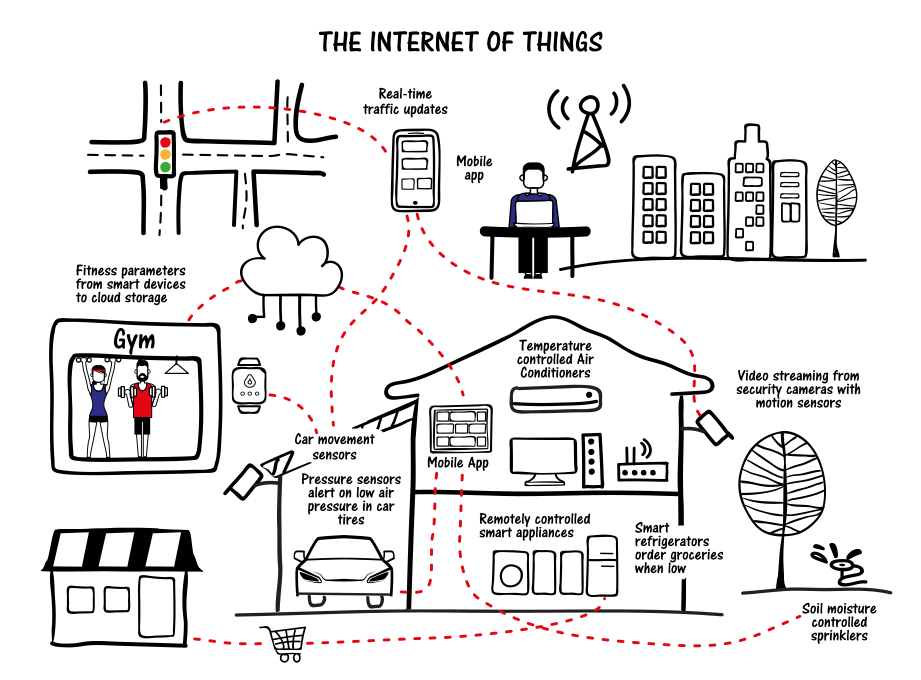
Solution Overview
The micro circuits you designed and built in the previous learning path were standalone circuits exchanging data and communicating only amongst themselves. In this learning path you will add another layer of services that will convert your standalone Physical Computing solution to a remotely connected Internet of Things solution.
With this, you will build a Smart Home solution, with sensors, relays, and actuators. Sensors placed at various locations in the house will capture data such as temperature and detect a gas leak and send the data to an IoT app on your smart phone, either via MQTT over the Internet or directly using Bluetooth Low Energy.
Sensors will also detect state changes in the home and take some action. For example, they will detect motion and turn on (and off) a light using a relay or measure plant soil moisture levels and start (and stop) the flow of water using an actuator valve. Alternately you can turn a light on or off or start or stop the flow of water from your smartphone by sending a signal from your smart phone via MQTT or over BLE.
Learning Objectives
This learning path introduces you to the fundamentals of building Physical Computing solutions. You will learn about the various microcontroller boards and how to design and assemble circuits. You will learn programming concepts and languages with a focus on microcontrollers. You will learn about the various components that go into building a solution including sensors, controllers, input and output devices, and data transmission and communication protocols.
At the end of this learning path, you will have achieved the following:
The checklist above is currently for you to manually track your completion status. We will soon be upgrading this to allow the learning objective to be checked based on the outcome of a quiz.